
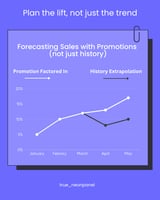
TL;DR: Most forecasting tools simply extend your past sales with a bit of trend and seasonality....
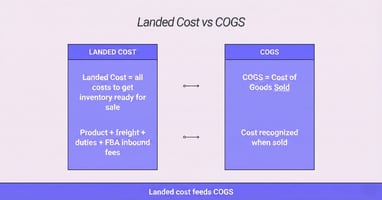
TL;DR: Most Amazon sellers only treat product cost as “inventory” and expense FBA/AWD inbound fees and 3PL handling straight to the P&L. That makes margins look worse, inventory look smaller, and valuations lower than they should be. A proper landed-cost policy capitalizes those inbound costs into inventory, increases reported EBITDA, and pushes up your brand’s exit value.
The problem: you are “eating” inbound costs as expenses
The typical Amazon seller workflow looks like this:
-
Product cost gets booked into inventory
-
Freight, duties, cross-dock, and FBA/AWD inbound fees get booked as operating expenses
-
3PL intake, labeling, and transfer costs get scattered across “Shipping,” “Warehouse,” or “Misc”
On paper, this feels conservative:
“I’m expensing more today, so I’m not inflating profit.”
In reality, you’re doing two things:
-
Understating gross margin and EBITDA
You are treating direct inventory acquisition costs as if they were overhead. -
Understating inventory value on the balance sheet
Your inventory is shown at product cost only, not at full landed cost.
That hurts you twice when it’s time to raise capital or sell.
Buyers often think in terms like:
Up to 4 × Profit + Inventory
If both “Profit” and “Inventory” are understated, the formula works against you.
What full landed cost should include
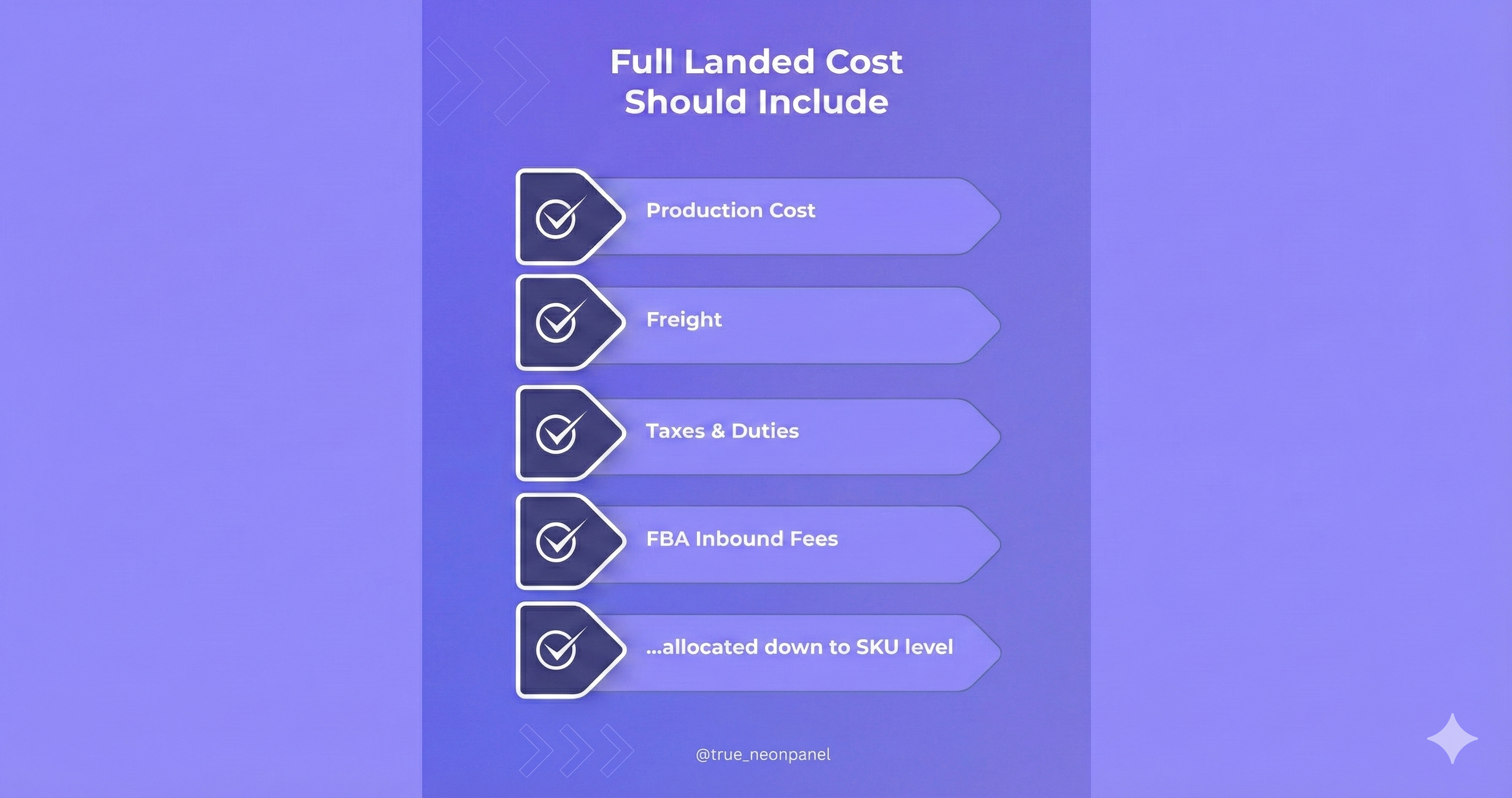
A full landed cost per unit should include:
-
Production cost
The amount you pay your manufacturer per unit (including packaging, inserts, and ex-factory charges). -
Freight
Ocean, air, or ground transportation from supplier to your first receiving point (port, cross-dock, 3PL, or AWD). -
Taxes and duties
Customs duties, import VAT (where non-recoverable), brokerage fees, and other border charges directly tied to that shipment. -
FBA and AWD inbound fees
For example:-
AWD receiving and handling fees
-
FBA partnered carrier or inbound placement fees
-
Cross-dock and transfer costs dedicated to getting units into FBA/AWD
-
-
Allocated down to SKU level
All of the above allocated across units in the shipment or batch (by units, weight, volume, or value) so every unit carries its fair share.
If you only track production cost, your margins will always look better on paper than they really are. If you track all of the above but expense them, your margins look worse than they should under a proper landed-cost policy.
Why capitalizing inbound costs lifts both profit and inventory
From an accounting perspective, costs that are directly attributable to bringing inventory to its present location and condition can be capitalized into inventory rather than expensed immediately.
Practically, for an Amazon seller, this means many FBA/AWD and 3PL inbound fees belong in inventory, not in “Shipping and Fulfillment Expense.”
When you capitalize them, three good things happen.
1. Reported profit (EBITDA) increases
Instead of all inbound fees hitting the P&L today, they move into inventory and get expensed gradually as COGS when you actually sell the units.
Example:
-
Profit before inbound costs: $500,000
-
Inbound FBA/AWD and 3PL costs: $100,000
If you expense them:
-
EBITDA = $400,000
If you capitalize them:
-
EBITDA = $500,000
-
The 100,000 becomes part of inventory and will flow into COGS as units sell.
You did not “create” profit. You simply moved timing to match when revenue is recognized, which is exactly what a clean COGS and inventory model is supposed to do.
2. Inventory value increases
That same $100,000 now sits on your balance sheet as part of inventory:
-
Inventory at product cost only: say $400,000
-
Inventory at full landed cost: $500,000
This higher, more accurate inventory value improves net working capital and aligns your books with what a buyer actually pays for the stock.
3. Your valuation multiple works in your favor
Using the shorthand:
Up to 4 × Profit + Inventory
With the numbers above:
-
If you expense inbound costs:
-
Profit = $400,000
-
Inventory = $400,000
-
Value ≈ 4 × $400,000 + $400,000 = $2,000,000
-
-
If you capitalize them:
-
Profit = $500,000
-
Inventory = $500,000
-
Value ≈ 4 × $500,000 + $500,000 = 2,500,000
-
Same underlying business, same shipments, same cash actually spent.
Just by applying a clean landed-cost policy and capitalizing eligible inbound fees, you improve the story buyers see by roughly $500,000 in this simplified example.
“Is this allowed?” What your CPA will say
The goal here is not to stretch rules. It is to:
-
Capitalize directly attributable inbound costs (freight, duties, handling, FBA/AWD receiving fees, etc.)
-
Leave selling, general, and administrative costs (ads, overhead, management salaries) in the P&L
Under standard accounting guidance, that is exactly how inventory accounting is supposed to work.
You should always align the policy with your CPA, but the underlying principle is straightforward:
If the cost is necessary to bring the product into sellable condition and location, it usually belongs in inventory, not as a period expense.
How NeonPanel helps you actually implement this
Knowing you should capitalize inbound costs is one thing. Doing it consistently, across hundreds of POs and shipments, is another.
In NeonPanel, we focus on three steps.
1. Review your current landed-cost policy
We help you clarify:
-
Which inbound costs are currently being expensed
-
Which should be candidates for capitalization
-
How those costs show up today in your accounting system (QuickBooks/Xero) and spreadsheets
2. Update the policy to include FBA/AWD and 3PL inbound fees
Together with your CPA, you can decide:
-
Which FBA/AWD receiving, placement, and inbound fees should roll into inventory
-
Which 3PL charges are truly part of getting inventory into sellable condition
-
How to group and allocate those costs (per shipment, per container, per SKU)
NeonPanel then lets you configure those rules so they are applied the same way every time.
3. Automate allocation and capitalisation
Once the policy is set, NeonPanel:
-
Pulls in PO, freight, duties, and FBA/AWD inbound fees
-
Allocates them across units in each batch or shipment
-
Builds true landed cost at SKU level
-
Pushes the resulting inventory and COGS journals to your accounting software automatically
That means:
-
Every unit’s cost is “honest” by default
-
Your P&L reflects proper COGS instead of a mix of COGS and inbound overhead
-
Your inventory valuation report is ready for lenders and buyers without spreadsheet surgery
What this means when you think about an exit
When buyers and investors dig into your numbers, they care about:
-
Are your margins real and repeatable
-
Is your inventory valued correctly
-
Are there any accounting “surprises” that justify a price cut
A disciplined landed-cost policy that capitalizes eligible inbound fees ticks all three boxes:
-
Margins are trued up and consistently calculated
-
Inventory reflects what you actually paid to land the stock
-
There are fewer adjustments during quality of earnings and due diligence
That is why sellers who do this early often see a higher multiple and fewer last-minute valuation reductions.
.png?height=200&name=Accounting%20Matters%20(EBITDA).png)