

What is Landed Cost and Why It Matters in Business In this article What Is Landed Cost? How to...
TL;DR: Landed cost is everything it takes to get inventory ready for sale (capitalized into inventory). COGS is the slice of those costs you recognize only when you sell units (e.g., per order). Landed cost builds the value of your stock; COGS relieves that value as you sell.
In this article
- Why sellers mix these up
- Working definitions (plain English)
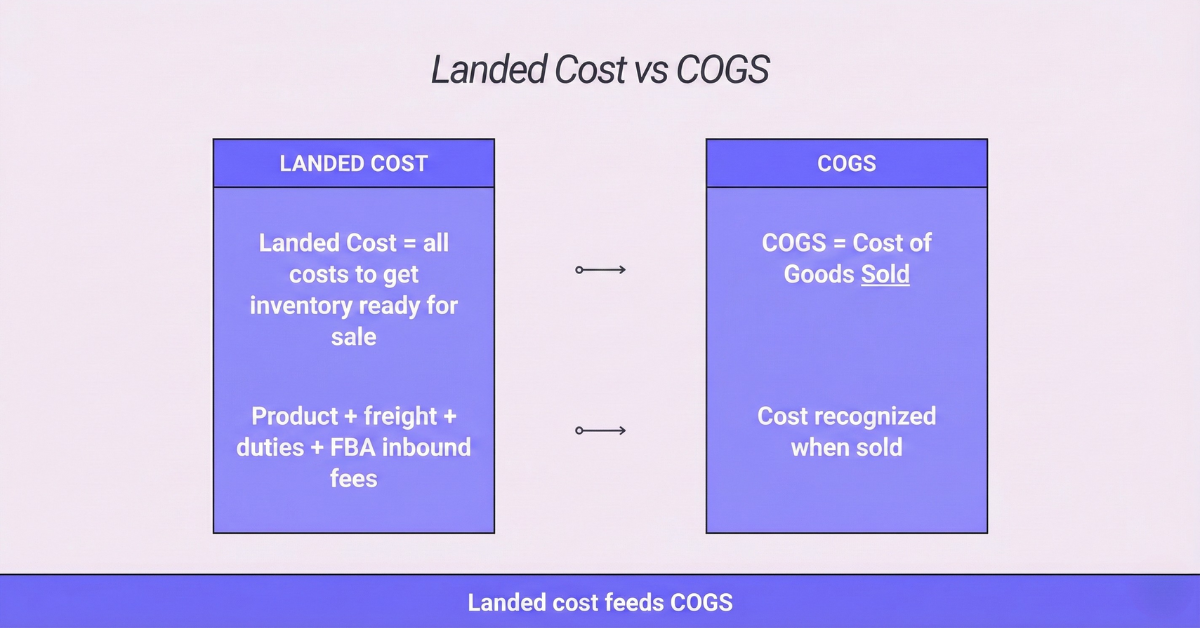
- The key difference in one picture
- A simple numeric example
- Multi-SKU landed cost allocations (how to split freight/duty)
- What not to capitalize into landed cost
- COGS ≠ Full Unit Economics (and that’s okay)
- Accounting flows (at a glance)
- Why this matters
- FAQ
Why sellers mix these up
Both deal with “cost,” but they happen at different times and hit different accounts. If you blur them, margins swing, inventory values drift, and month-end drags on.
Working definitions (plain English)
Landed Cost (Inventory Value):
All costs to bring goods to your shelf/in a condition for sale:
-
Product/Factory cost
-
Freight & drayage (ocean/air/ground), last-mile to 3PL or FBA
-
Import duties, brokerage, insurance
-
Handling, palletizing, labels/packaging related to getting inventory sale-ready
Typically not included: PPC/ads, Amazon referral fees, pick & pack, storage after ready-for-sale (period expenses).
COGS (Expense when you sell):
The per-unit cost (from your landed cost layers, e.g., FIFO) × units sold.
-
Recognized at the moment of sale
-
Reduces inventory asset and increases COGS expense
The key difference in one picture
Timeline: PO created → freight/duty paid → inventory received (landed cost capitalized) → units sold (COGS recognized).
-
Before the sale: costs live in Inventory (Asset)
-
At the sale: a portion moves to COGS (Expense)
A simple numeric example
PO: 1,000 units
-
Factory: $7.00 = $7,000
-
Freight: $2,000
-
Duty: $500
-
3PL receiving/labels: $300
Total landed cost: $9,800
Per-unit landed cost: $9.80
If you sell 300 units this month:
-
COGS this month = 300 × $9.80 = $2,940
-
Inventory balance after = $6,860 (700 units left)
With FIFO, later POs at different costs form new layers. Sales pull from the oldest available layer first.
Multi-SKU landed cost allocations (how to split freight/duty)
When a container carries multiple SKUs, use a fair basis to allocate shared costs:
-
By Units (simple when items are similar)
-
By Weight (fair for heavy goods)
-
By Volume/CBM (fair for bulky goods)
-
By Value (aligns with customs approaches)
What not to capitalize into landed cost
-
Amazon referral fees and pick & pack → selling expenses
-
PPC/ads → marketing expense
-
Storage beyond “getting sale-ready” → period expense
-
Chargebacks/penalties → period expense
(Edge cases exist; follow a consistent policy.)
COGS ≠ Full Unit Economics (and that’s okay)
COGS is an accounting metric, not a complete picture of per-unit profitability. If you want true unit economics for operational decisions, you’ll layer in additional variable and semi-variable costs that are not part of COGS:
-
Variable selling costs: referral fees, pick & pack, payment processing, shipping to customer
-
Marketing: PPC spend attributable to a SKU or campaign
-
Holding costs: storage before sale (monthly FBA/3PL storage, AWD storage)
-
Other direct operational costs tied to getting a unit sold
Operational unit economics (simplified):
Unit Profit (ops) = Net Revenue per unit − COGS per unit − (Variable selling costs per unit) − (Allocated PPC per unit) − (Allocated storage per unit)
That operational view helps with pricing, budgeting ad spend, and SKU decisions, but it won’t match your accounting COGS or landed cost balances—nor should it. They answer different questions:
-
COGS & Landed Cost (Accounting): What is the book value of inventory and the expense recognized at sale?
-
Unit Economics (Operational): Are we actually making money per unit after fees, storage, and ads?
Accounting flows (at a glance)
When inventory is received (bill posted):
-
Dr Inventory (Asset) = landed cost
-
Cr A/P, Accrued Freight/Duty, etc.
When you sell:
-
Dr COGS = units sold × per-unit cost (from FIFO layer)
-
Cr Inventory (Asset)
Adjustments/returns:
-
Restock returns back into inventory at the correct cost layer
-
Write-offs/disposals → Dr COGS/Write-off, Cr Inventory
Why this matters
-
True margins: Ads/fees don’t pollute your unit costs; costs are recognized at the right time.
-
Clean close: Inventory valuation matches reality; COGS ties to orders.
-
Smarter pricing: Combine accounting COGS with operational fees for real-world unit economics.
-
Fewer disputes: Your CPA and your dashboard agree.
How NeonPanel handles this (so you don’t)
Today
-
Capture landed costs from POs, freight, duties, insurance, handling; allocate by units/weight/volume/value.
-
Build FIFO cost layers and keep them synced across 3PL ↔ FBA/AWD.
-
Recognize COGS per order (Amazon, Shopify, TikTok, etc.).
-
Post clean journal entries to QBO/Xero using your Chart of Accounts (e.g., split sales by channel/country).
What’s coming (operational view)
-
Optional per-unit operational allocations for non-COGS expenses (e.g., PPC, storage, variable marketplace fees) to show SKU-level unit economics and contribution margin—separate from accounting COGS/landed cost.
-
Clear labeling so teams understand: Accounting COGS (for the books) vs Operational unit economics (for decisions).
Further reading: What Is COGS and How to Calculate It · Fully Landed Cost Explained · What Is Landed Cost and Why It Matters
Frequently Asked Questions
Which expenses belong in COGS versus operating expenses?
Expenses belong in COGS only if they are part of capitalized inventory cost and are recognized at the moment units are sold. These costs originate in inventory (as landed cost) and move into COGS through FIFO or another valuation method when a sale occurs. Operating expenses are costs related to selling, marketing, fulfillment, and ongoing operations, such as PPC, Amazon referral fees, pick & pack, post–ready-for-sale storage, penalties, and overhead. The key difference is timing and purpose, not whether the cost feels variable.
Which landed cost components should be capitalized into inventory?
Landed cost components that should be capitalized are those directly required to bring inventory to its present location and sellable condition. These typically include factory cost, inbound freight, customs duties and brokerage, insurance, and required handling or labeling needed to make units sale-ready. Costs that relate to selling, advertising, customer delivery, or holding inventory after it is already sellable are treated as period expenses, not inventory.
How should COGS and landed cost be handled under FIFO versus weighted average?
Under FIFO, landed costs are stored in batch-level cost layers, and COGS is recognized by relieving the oldest available layer first as units sell. Under weighted average, all inventory costs are blended into a single average cost per unit that updates as new inventory is received. Both methods are acceptable, but the accounting outcome depends on consistency. The same landed cost inputs behave differently depending on how COGS is released.
How should shipping and customs costs be allocated across multiple SKUs?
Shipping and customs costs shared across multiple SKUs should be allocated using a reasonable and consistently applied basis that reflects how costs are incurred. Common allocation bases include units, weight, volume (CBM), or value. The goal is not mathematical perfection, but defensible consistency so SKU-level inventory values and margins remain comparable across periods.
What impact does landed cost have on product pricing and profit margins?
Landed cost defines the true acquisition cost floor for a product. If landed cost is incomplete or misclassified as expenses, margins can appear artificially low or high, leading to distorted pricing decisions. Accurate landed cost ensures that pricing, discounts, and margin analysis are based on the real economics of getting inventory ready for sale, while COGS ensures those costs hit the P&L at the correct time.
Why is contribution margin per SKU different from COGS-based profitability?
Contribution margin per SKU includes additional variable and semi-variable costs—such as marketplace fees, PPC, and storage—that are intentionally excluded from accounting COGS. COGS answers the accounting question of inventory valuation and expense timing, while contribution margin answers the operational question of whether a unit is truly profitable after selling costs. Both metrics are valid, but they serve different purposes and should not be conflated.