
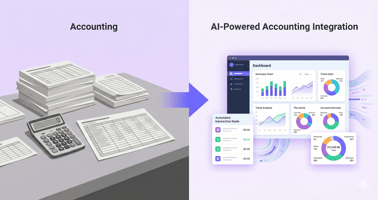
The accounting industry has always evolved alongside technological progress. From paper ledgers to...

How to choose AI agents for team operations
As organizations scale, managing complex workflows across multiple tools, teams, and data sources becomes increasingly difficult. This is where AI agents are transforming modern workplaces. Instead of relying on a single automation tool, companies are now experimenting with an interconnected AI agents team that can collaborate, reason, and execute multi-step tasks across different business functions.
Choosing the right solution requires understanding operational needs, technical constraints, and long-term business goals. This guide explains how to evaluate and select AI agents for team operations in a structured and practical way.
What Are AI Agents for Team Operations?
AI agents for team operations are autonomous or semi-autonomous software systems designed to perform tasks, make decisions, and collaborate within a business environment. Unlike traditional automation tools that follow fixed rules, AI agents can interpret context, adapt to changes, and execute multi-step workflows.
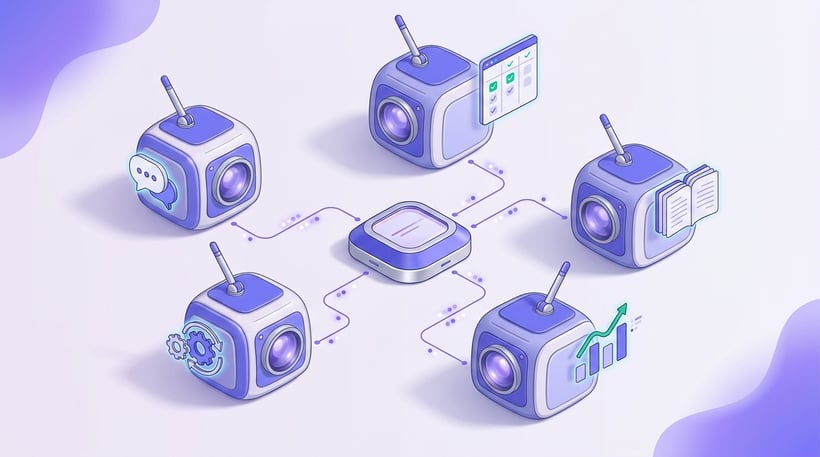
In practice, a team of AI agents can handle responsibilities such as reporting, customer communication, task automation, and internal knowledge retrieval. Each agent may specialize in a specific function while still coordinating with others as part of a larger system.
Why Businesses Are Adopting AI Agents
Companies adopt AI agents mainly to improve efficiency and reduce manual workload. As operations grow, scaling human teams alone becomes expensive and slow.
Key benefits include:
- Automation of repetitive tasks
- Faster decision-making through real-time insights
- Reduced operational errors
- Improved cross-team coordination
- Continuous 24/7 execution of workflows
Organizations exploring how to build a team of AI agents often find that multi-agent systems can parallelize work more effectively than traditional automation tools, improving speed and responsiveness.
Identify Your Team’s Operational Needs Before Choosing an AI Agent
Before selecting an AI agent solution, take time to assess your team's operational needs. Many organizations adopt AI tools without clearly understanding their challenges, which can lead to poor results. A clear view of workflows, inefficiencies, and business goals helps ensure a successful implementation.
Start by reviewing your current processes and identifying areas where AI could provide the most value. Focus on:
- Repetitive manual tasks
- Communication bottlenecks
- Data-heavy processes
- Cross-platform workflows
- Error-prone operations
- Reporting and documentation tasks
It is also important to define clear objectives, such as reducing costs, improving productivity, speeding up project delivery, or enhancing customer service. Different AI agents are designed for different outcomes, so understanding your priorities will help narrow the selection process.
Involving key stakeholders from different departments can also provide valuable insights into operational challenges and opportunities for improvement.
Once your needs and goals are clearly defined, you can match them with the capabilities of available AI agents and make a more informed decision.
Key Features to Look for in AI Agents
When evaluating AI agents, focus on functional depth rather than surface-level features. The most effective solutions are those that can adapt to changing business requirements, work across multiple systems, and support collaboration between both humans and other AI agents.
Important capabilities include:
- Multi-step workflow automation
- Context retention and memory
- Task delegation between agents
- Natural language interaction
- Real-time analytics and reporting
- Cross-system coordination
- Learning and adaptation based on historical interactions
- Customizable workflows and business rules
- Integration with existing software and data sources
It is also important to assess how easily the system can be configured and scaled as operational demands grow. Some AI agents perform well in isolated tasks but struggle when required to coordinate across departments or manage complex workflows involving multiple stakeholders.
A strong solution should function as a coordinated system rather than an isolated tool,1 especially when building a scalable ai agents team. This approach enables organizations to automate larger portions of their operations while maintaining consistency, visibility, and control over business processes.

Evaluate Integration Capabilities
Integration is often the deciding factor in real-world adoption. Even the most advanced AI agent is limited if it cannot connect with your existing ecosystem and business processes. Smooth integrations help reduce manual work, improve data consistency, and enable agents to operate effectively across multiple platforms.
Common integration targets include:
- Project management tools
- CRM systems
- Communication platforms
- Internal databases
- External APIs
When evaluating solutions, consider not only the number of available integrations but also how easily they can be configured and maintained as your operational needs evolve.
Example Integration Comparison
| Integration Area | Basic AI Agents | Advanced AI Agent Systems |
|---|---|---|
| Project Management Tools | Limited or manual setup | Native, real-time synchronization |
| CRM Systems | Basic data access | Full workflow automation |
| Communication Tools | Single-channel support | Multi-channel coordination |
| API Connectivity | Restricted or static | Flexible, extensible APIs |
| Data Handling | Isolated processing | Cross-system data orchestration |
This comparison helps highlight whether a solution is suitable for simple automation or full-scale operational orchestration.
Security, Compliance, and Data Privacy Considerations
As AI agents handle sensitive business data, security must be a core evaluation factor. Whether agents are accessing customer records, internal documentation, financial information, or operational workflows, organizations need confidence that data is protected throughout every stage of processing.
Key requirements include:
- End-to-end encryption
- Role-based access control
- Audit logs for all actions
- Regulatory compliance (GDPR and industry standards)
- Clear data ownership policies
- Secure authentication and user verification
- Regular security updates and vulnerability monitoring
It is also important to understand how vendors store, process, and retain data. Businesses should review data handling practices, incident response procedures, and transparency around model training and third-party integrations. For organizations operating in regulated industries, compliance requirements may be just as important as functionality when evaluating AI solutions.
Without these safeguards, scaling AI systems can introduce significant risks, including unauthorized access, data breaches, compliance violations, and loss of customer trust. A strong security framework helps ensure that AI agents can be deployed confidently and responsibly across team operations.
Compare Different Types of AI Agents for Team Operations
Different AI agents serve different operational purposes. The table below highlights the main categories and their typical use cases.
| Agent Type | Primary Function | Typical Users | Key Benefit |
|---|---|---|---|
| Customer Support Agent | Customer communication and issue resolution | Support teams | Faster response times |
| Project Management Agent | Task coordination and project tracking | Project managers | Improved team productivity |
| Knowledge Management Agent | Information retrieval and documentation support | Employees across departments | Faster access to knowledge |
| Data Analysis Agent | Reporting and insight generation | Analysts and executives | Better decision-making |
| Workflow Automation Agent | Process execution and system coordination | Operations teams | Reduced manual effort |
A well-designed team of AI agents often combines multiple agent types into a unified operational system, allowing each agent to specialize in a specific function while working together to improve overall efficiency.
Common Mistakes When Choosing AI Agents
Many organizations struggle not because of technology limitations, but because of poor selection decisions.
Common mistakes include:
- Choosing based only on price
- Ignoring integration complexity
- Overestimating out-of-the-box capabilities
- Skipping real-world testing
- Failing to prepare teams for adoption
Avoiding these issues significantly improves success rates.
Conclusion
Selecting AI agents for team operations is a strategic decision that goes beyond tools and features. It requires aligning technology with workflows, ensuring integration readiness, and planning for scalability.
As organizations explore how to choose ai agents for team operations, the focus is shifting from individual tools to coordinated ecosystems—true team of ai agents setups that can operate collaboratively across business functions.
When implemented correctly, these systems improve efficiency, reduce costs, and enable more intelligent, scalable operations.
1 A coordinated system means agents share context and hand off tasks to one another, rather than each tool running in isolation — the practical difference between a single automation and a true multi-agent setup.
FAQ
⌃How to choose AI agents for team operations in a growing business?
Start by analyzing your workflows, identifying bottlenecks, and clearly defining what you want to improve before selecting any solution.
⌃What are the main benefits of using an AI agents team in daily operations?
They help automate repetitive tasks, improve coordination, and increase overall efficiency across different departments.
⌃How to build a team of AI agents for different business tasks?
Begin by mapping out key business functions and assigning specialized digital agents to handle specific roles that support those processes.
⌃What features are most important when selecting AI tools for team workflows?
Focus on flexibility, ability to automate complex tasks, integration with existing tools, and support for scaling operations.
⌃How important is integration when selecting AI solutions for team operations?
It is critical because seamless connectivity with existing systems determines how effectively the solution can be used in real workflows.