
.png?height=200&name=Accounting%20Matters%20(EBITDA).png)
TL;DR: Most Amazon brands expense FBA inbound fees as operating costs. That pushes EBITDA down and...
In this article
TL;DR: Ecommerce product demand forecasting helps brands predict what will sell, when it will sell, and in what quantity using historical and real-time signals. As SKU complexity grows, automation and AI become essential for accuracy, faster planning, and better inventory control. Teams that align marketing, operations, and purchasing around one forecast model scale with fewer stockouts and less excess inventory.
What Is Demand Forecasting in E-commerce?
Before implementing tools or automation, it is important to understand the foundation. Ecommerce demand forecasting gives teams a structured way to predict future demand and align purchasing, marketing, and logistics decisions before problems appear.
Without structured forecasting, planning becomes reactive. Brands move from proactive growth to constant fire-fighting around stockouts, overstock, and campaign timing issues.
Understanding the basics of e-commerce product demand forecasting
Ecommerce product demand forecasting is the process of predicting future sales volume using historical performance, seasonality, campaign data, and market signals. At its core, forecasting answers three questions: what will sell, when it will sell, and in what quantity.
Effective demand forecasting ecommerce frameworks combine sales history, marketing calendars, inventory turnover data, supplier lead times, and external demand signals. The purpose of demand forecasting for ecommerce is operational alignment, so marketing, purchasing, and logistics work from the same projection model.
Why accurate forecasting is critical for growth
- Forecast accuracy directly influences profitability and working capital efficiency.
- Common consequences of poor planning include overstocked warehouses, dead inventory, missed sales opportunities, and margin erosion from urgent replenishment.
- Accurate demand forecasting ecommerce improves fulfillment reliability, supplier negotiations, campaign timing, and long-term customer trust.
Top Demand Forecasting Methods and Techniques
There is no universal forecasting formula. The right model depends on business maturity, data volume, and SKU complexity, so most scaling brands combine multiple approaches.
Qualitative vs. Quantitative demand forecasting methods
- Qualitative methods: Rely on expert insight, customer feedback, and market research when historical data is limited.
- Best use cases: Product launches, entering new markets, and trend-driven categories.
- Quantitative methods: Use statistical models such as moving averages, time-series analysis, regression models, and exponential smoothing.
Macro and micro demand forecasting techniques
- Macro-level forecasting: Evaluates total market demand and broader category trends.
- Micro-level forecasting: Focuses on SKU-level performance for better safety stock management and purchasing precision.
- Why it matters: Without micro-level visibility, inventory planning becomes too generalized and less operationally effective.
Seasonal and trend-based analysis
Seasonality is one of the most powerful drivers in ecommerce. Holiday peaks, promotional events, and weather changes can shift purchasing behavior quickly, so teams should continuously validate forecast assumptions.
- Review year-over-year comparisons and weekly sales velocity.
- Measure promotion uplift performance and trend acceleration signals.
- Monitor short-term demand spikes from social media and paid campaigns.
Demand Forecasting Automation for E-commerce
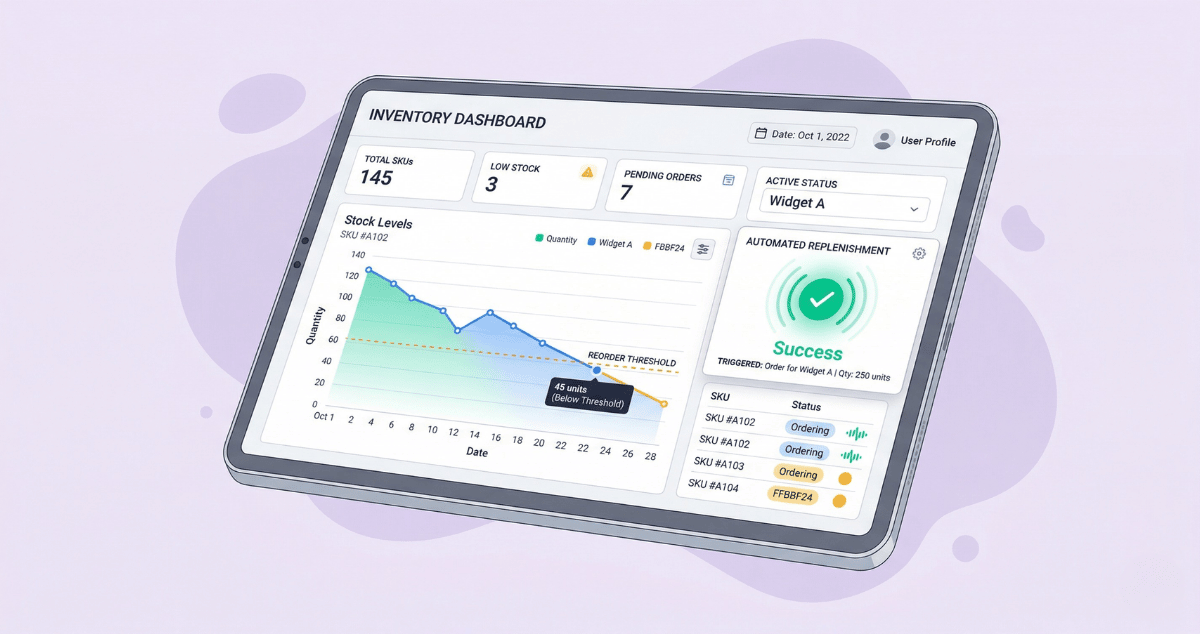
Manual spreadsheets often work in early stages, but complexity increases rapidly as SKU counts grow. This is where demand forecasting automation for ecommerce becomes essential.
- Reduce human error: Automation lowers risks from formula errors, version inconsistencies, and manual data transfer mistakes.
- Integrate systems: Connect inventory systems, ERPs, and marketing dashboards for real-time synchronization.
- Improve planning speed: Replace manual exports with continuous forecasting visibility, especially during peak seasons.
- Scale confidently: Use automation to keep forecasting consistent as operations and channel complexity grow.
When to switch to e-commerce demand forecasting software
- Forecast preparation consumes multiple days each cycle.
- Inventory discrepancies increase and scenario planning feels too slow.
- Scaling introduces friction that manual workflows cannot handle effectively.
The Role of AI in Demand Forecasting for E-commerce
Artificial intelligence has transformed predictive analytics across industries. Unlike traditional models that rely primarily on historical averages, AI for demand forecasting evaluates dynamic variables simultaneously and continuously improves as new data arrives.
How AI for demand forecasting changes the game
Machine learning models process real-time customer behavior, traffic fluctuations, pricing changes, and external economic indicators. Modern ai demand forecasting ecommerce platforms refine predictions continuously as new data becomes available, which improves accuracy over time.
Benefits of demand forecasting using AI over manual spreadsheets
Demand forecasting using AI provides automatic anomaly detection, real-time updates, predictive scenario testing, and faster decision cycles. For scaling brands, ai demand forecasting ecommerce is a competitive advantage because it adapts quickly to disruptions such as viral demand spikes or supplier delays.
Best Practices for Implementing a Forecasting Strategy
Even the best software requires structured processes. Forecast precision depends on clean inputs and consistent collaboration between marketing and operations teams.
Data collection and cleaning
- Data quality first: Standardize SKU naming, remove duplicates, separate returns from sales, and verify supplier lead-time accuracy.
- Even advanced ecommerce demand forecasting software cannot compensate for inconsistent inputs.
- Clean data improves model stability and long-term reliability.
Collaborating across marketing and operations
- Cross-functional alignment: Sync marketing calendars with supply chain planning to absorb promotional pressure.
- Operational rhythm: Run weekly forecast reviews, campaign impact simulations, inventory threshold alerts, and supplier communication planning.
Streamline your forecasting with NeonPanel
NeonPanel centralizes forecasting, analytics, and automation into a unified environment so teams can make faster decisions with less manual work and fewer operational blind spots.
Streamline your forecasting with NeonPanel
Conclusion
Scaling ecommerce brands need clarity and speed, but disconnected systems create blind spots and manual workflows slow execution. With advanced dashboards and predictive modeling, teams can improve inventory turnover, reduce excess stock, plan promotions confidently, and align operations across departments. A structured forecasting workflow is not just about numbers. It is about building operational stability that supports long-term growth.
Further reading: Amazon Seller Bookkeeping Guide · COGS vs Landed Cost · How to Track Sales on Amazon
Frequently Asked Questions
How to map Amazon fee types to COA accounts?
Amazon fee types should be mapped to the Chart of Accounts using a standardized, channel-agnostic taxonomy, not ad-hoc buckets. Each fee category (referral, fulfillment, payment processing, storage, program fees) should always land in the same COA account every month, regardless of SKU or campaign. The goal is consistency: when the same economic activity happens, it should hit the same account so margins, trends, and comparisons remain reliable over time.
What are best practices for classifying FBA fees as COGS or operating expenses?
Best practice is to classify FBA fees based on when and why the cost is incurred, not how inventory-like it feels. Only costs that are capitalized into inventory and relieved at the moment of sale belong in COGS. FBA referral fees, pick & pack, weight handling, storage, and program fees are selling or operating expenses and should remain separate from COGS to preserve clean margin visibility.
How to reconcile Amazon settlements to QuickBooks step by step?
Amazon settlements should be reconciled by tying settlement summaries to posted journals and then to bank deposits, rather than matching individual orders. At month end, total settlement amounts (net of fees, refunds, and reserves) should align with the journals posted to QuickBooks and the cash actually received, allowing for timing differences. This approach ensures completeness and prevents mystery variances caused by missing data or inconsistent mappings.
How can marketplace fee imports be automated using NeonPanel or alternative tools?
Marketplace fee imports can be automated by using tools that apply rule-based mappings from settlement lines directly into your COA. Automation works best when the underlying taxonomy is already defined—so new fee codes are reviewed and mapped once, then handled consistently going forward. The value of automation is not speed alone, but repeatability and fewer reclasses at month end.
How should fulfillment-related fees be classified as COGS versus operating expenses?
Fulfillment-related fees should be classified based on whether they relate to acquiring inventory or selling an order. Costs incurred to get inventory ready for sale (before it is sellable) may be capitalized into inventory, while costs incurred to fulfill customer orders belong in operating expenses. In practice, FBA pick & pack, last-mile delivery, and per-order handling fees are operating expenses, not COGS—even though they vary with sales volume.