
Table of Contents
In the world of e-commerce, revenue is vanity, but profit is sanity. For Amazon sellers, the bridge between high revenue and actual money in the bank is built on one critical metric: Cost of Goods Sold (COGS). Many sellers rely on rough estimates or "napkin math," but as your brand scales, precision becomes non-negotiable.
Understanding what COGS are in amazon operations and how to calculate it properly is the difference between a business that bleeds cash and one that scales sustainably. This guide will walk you through the essential amazon formulas, the components of landed cost, and how to automate this complex process.
What Is COGS in Amazon and Why It Matters
COGS explained in simple terms
At its core, cost of goods sold amazon metrics represent the direct costs attributable to the production of the goods sold by a company. For an Amazon seller, this isn't just the price you paid the manufacturer. It includes every dollar spent to get that specific unit to the fulfillment center, ready to be sold.
When we discuss cog amazon (Cost of Goods), we are moving from cash-basis accounting (recording expense when cash leaves the bank) to accrual accounting (recording expense when the sale happens). This distinction is vital. You might buy $50,000 of inventory in January, but if you only sell half of it in February, your cost of goods sold computation for February should only reflect the cost of the units sold, not the total purchase order.
How understanding COGS improves profitability
If you don't know how to get cost of goods sold accuracy down to the penny, you cannot calculate your true margins. Sellers often underprice their products because they fail to factor in freight, duties, or prep fees into their unit economics. By mastering your cogs amazon data, you can identify which SKUs are actually profitable and which are draining your working capital.
Key Components of Amazon Cost of Goods Sold
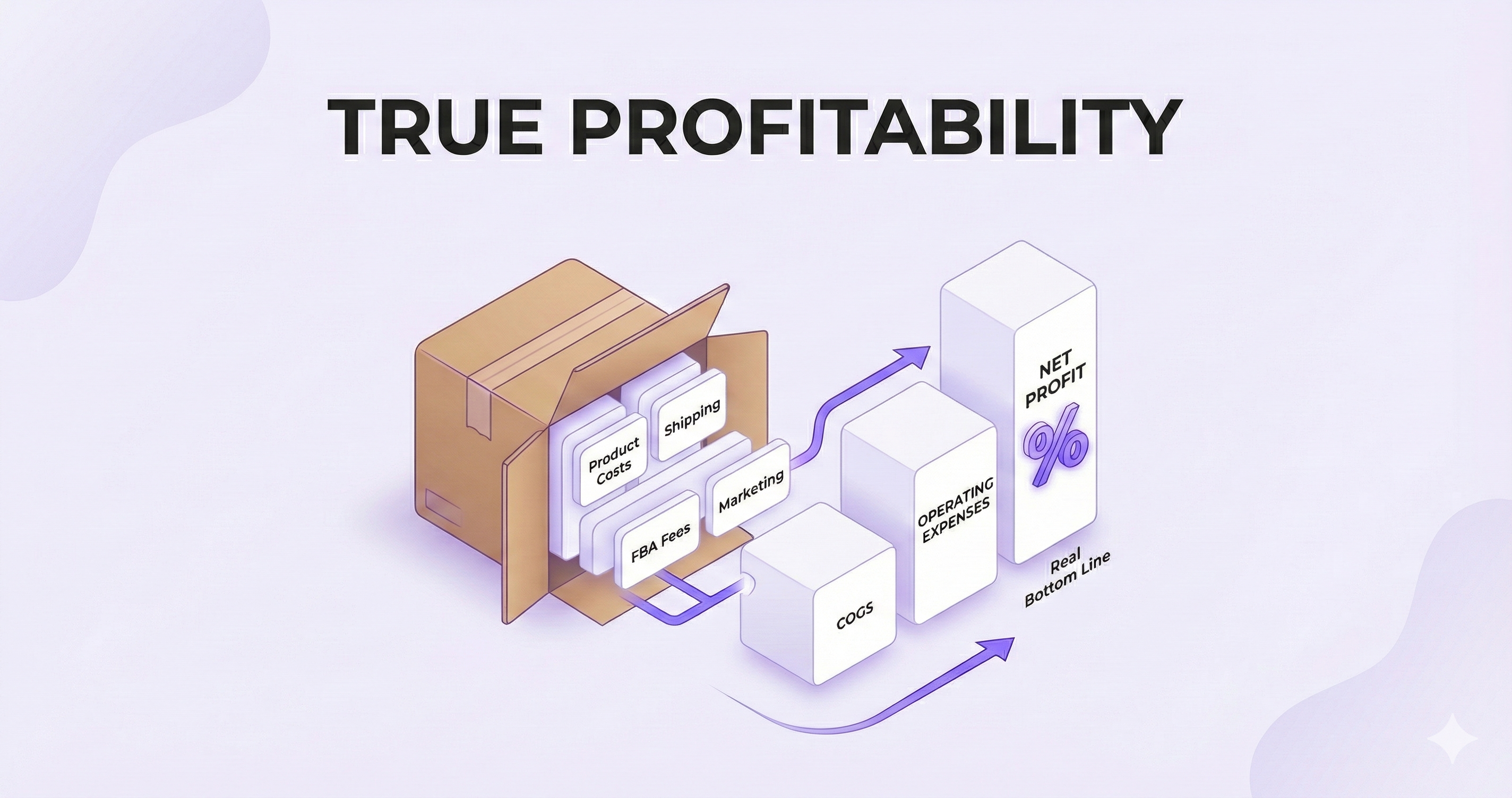
To perform a correct cost of goods sold computation, you must look beyond the factory invoice. A true "Landed Cost" includes several layers.
Product purchase cost
This is the base manufacturing cost per unit. While this is the most obvious part of the amazon cost of goods sold, relying on this number alone is a fatal error.
Shipping and Inbound Fees in Shipped COGS Amazon
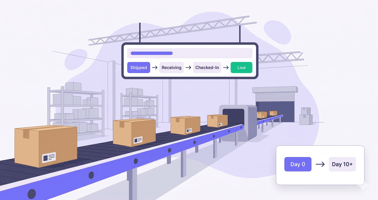
Freight is often the second largest expense after manufacturing. When tracking your financials, you may encounter the term shipped cogs amazon. The shipped cogs amazon meaning generally refers to the cost of inventory that has physically left your possession (shipped to the customer), inclusive of the inbound shipping costs required to get it to Amazon's warehouse.
You must allocate your ocean freight, drayage, and air shipping costs to the specific batches of inventory they apply to. Failing to include these leads to artificially inflated profit reports.
Duties, taxes, packaging
Customs duties (Tariffs) can add 25% or more to your unit cost. Additionally, product packaging and inserts are direct material costs. When you calculate costs of goods sold, these must be allocated to the specific units.
Other direct costs (prep, labeling, returns)
If you use a 3PL for prep, labeling, or kitting, those service fees are part of your COGS. Furthermore, knowing how to determine the cost of goods sold involves accounting for returns. When a unit is returned and unfulfillable, that cost must be realized.
How to Calculate COGS on Amazon
Standard Cost of Goods Sold Formula for Amazon Sellers
The standard cost of good sold formula used in accounting is:
Beginning Inventory + Purchases (during the period) - Ending Inventory = COGS
However, for e-commerce, using a "Periodic" calculation like this can be inaccurate due to price fluctuations.
Step-by-step cost breakdown
To accurately calculate costs of goods sold, follow this workflow:
-
Identify the Batch: Know exactly which shipment the unit came from.
-
Sum All Costs: Add Manufacturing + Freight + Duties + Prep for that batch.
-
Divide by Quantity: Determine the precise Landed Cost per unit.
-
Multiply by Sales: Multiply that unit cost by the number of units sold in the period.
Amazon-specific calculation workflow
Because Amazon receives inventory at different times, you might have the same SKU with different costs (e.g., a batch shipped by sea vs. a batch shipped by air). To solve this, you need advanced amazon formulas that utilize FIFO (First-In, First-Out) logic. This ensures that the cost of goods sold amazon reflects the actual batch being sold, not just an average.
Simple examples for Amazon sellers
Let's look at how do you compute the cost of goods sold in a real scenario:
-
Batch A (Sea): 1,000 units. Landed Cost: $10/unit.
-
Batch B (Air): 500 units. Landed Cost: $14/unit.
-
Sales: You sell 1,200 units.
Using FIFO amazon formulas:
-
You sell all 1,000 units of Batch A @ $10 = $10,000.
-
You sell 200 units of Batch B @ $14 = $2,800.
-
Total COGS: $12,800.
If you simply averaged the cost ($11.33), your COGS would be $13,596, giving you inaccurate financial data. This highlights why understanding shipped cogs amazon logic is critical.
Common COGS Mistakes to Avoid
Ignoring shipping and handling costs
Many sellers expense shipping immediately rather than capitalizing it into inventory. This creates massive swings in your P&L. If you want to know how to get cost of goods sold right, you must capitalize freight and release it to COGS only when the unit sells.
Overlooking prep and storage fees
Amazon AWD and FBA storage fees are operating expenses, but prep fees to get the item ready for sale should often be part of the COGS. Ignoring this distorts the shipped cogs amazon meaning regarding profitability.
Not accounting for returns and allowances
When a customer returns an item, it isn't always sellable. How to determine the cost of goods sold correctly involves writing off the cost of damaged returns as a loss/expense, distinct from standard COGS.
How to Improve and Monitor Your COGS
Using automation & inventory software
Manual spreadsheets break. They cannot handle FIFO layers or currency conversions effectively. Using software that automates amazon sales formula calculations and COGS tracking allows for real-time visibility.
Regular cost audits
Quarterly, you should review your cost of goods sold computation against your actual supplier invoices and freight bills. Check for variances in landed cost assumptions versus reality.
Aligning forecasting with pricing strategy
If you know what is cogs in amazon for your next batch (perhaps freight rates are rising), you can adjust your retail pricing before the inventory lands to protect your margin.
Automate Your COGS Tracking with NeonPanel
Reduce manual work and avoid calculation errors
NeonPanel replaces spreadsheets with a unified system that unifies inventory and finance. By automating the cost of good sold formula using true batch-level tracking, NeonPanel eliminates the human error associated with manual entries.
Get real-time cost visibility and accurate profit data
NeonPanel provides true SKU-level profit and COGS for every order, tracking cog amazon data across every marketplace and currency. Unlike tools that use averages, NeonPanel uses actual batch costs, ensuring that when you ask how do you compute the cost of goods sold, the answer is audit-ready.
Use NeonPanel to streamline your Amazon operations
From syncing seamlessly with QuickBooks and Xero to handling complex amazon sales formula variables like FBA fees and PPC, NeonPanel serves as a single source of truth. It allows you to visualize the shipped cogs amazon impact on your bottom line instantly.
Start your free trial today to get accurate profitability and automated accounting in minutes.