

Every Amazon seller eventually hits the same wall.
More SKUs. More marketplaces. More ad campaigns. More data.
Spreadsheets stop working. Manual checks don't scale. Small delays turn into stockouts or wasted ad spend. That's where amazon seller automation explained becomes operational — not theoretical.
Automation connects your data, applies predefined logic, and executes actions automatically. It replaces repetitive execution, not strategic judgment.
Done correctly, automation improves:
- operational efficiency
- data monitoring
- cross-market synchronization
- reporting consistency
- scalability without hiring
This is infrastructure, not a convenience feature.
How Amazon automation works in real seller workflows
So, how does amazon automation work in practice? It follows a predictable system:
- Data flows in (sales, ads, inventory levels).
- Analytics evaluates thresholds.
- A trigger fires.
- An automated action executes.
Example workflow:
- Inventory drops below safety stock
- Reorder pipeline activates
- Supplier notification is scheduled
- Forecast updates in dashboards
These are structured automation workflows for Amazon sellers — rule-based systems that operate continuously in the background. The seller stays in control. The system handles execution.
Manual workflows vs automated systems
Manual workflow at scale requires pulling reports daily, updating spreadsheets, checking SKU by SKU, sending supplier emails, and adjusting bids manually.
An automated system delivers continuous monitoring, predefined reorder rules, automatic scheduling, centralised dashboards, and real-time alerts.
Manual execution slows growth. Systems enable scaling.
What Can Be Automated in Amazon FBA
A common operational question is: what can be automated in amazon fba safely? More than most sellers expect.
High-impact automation areas include:
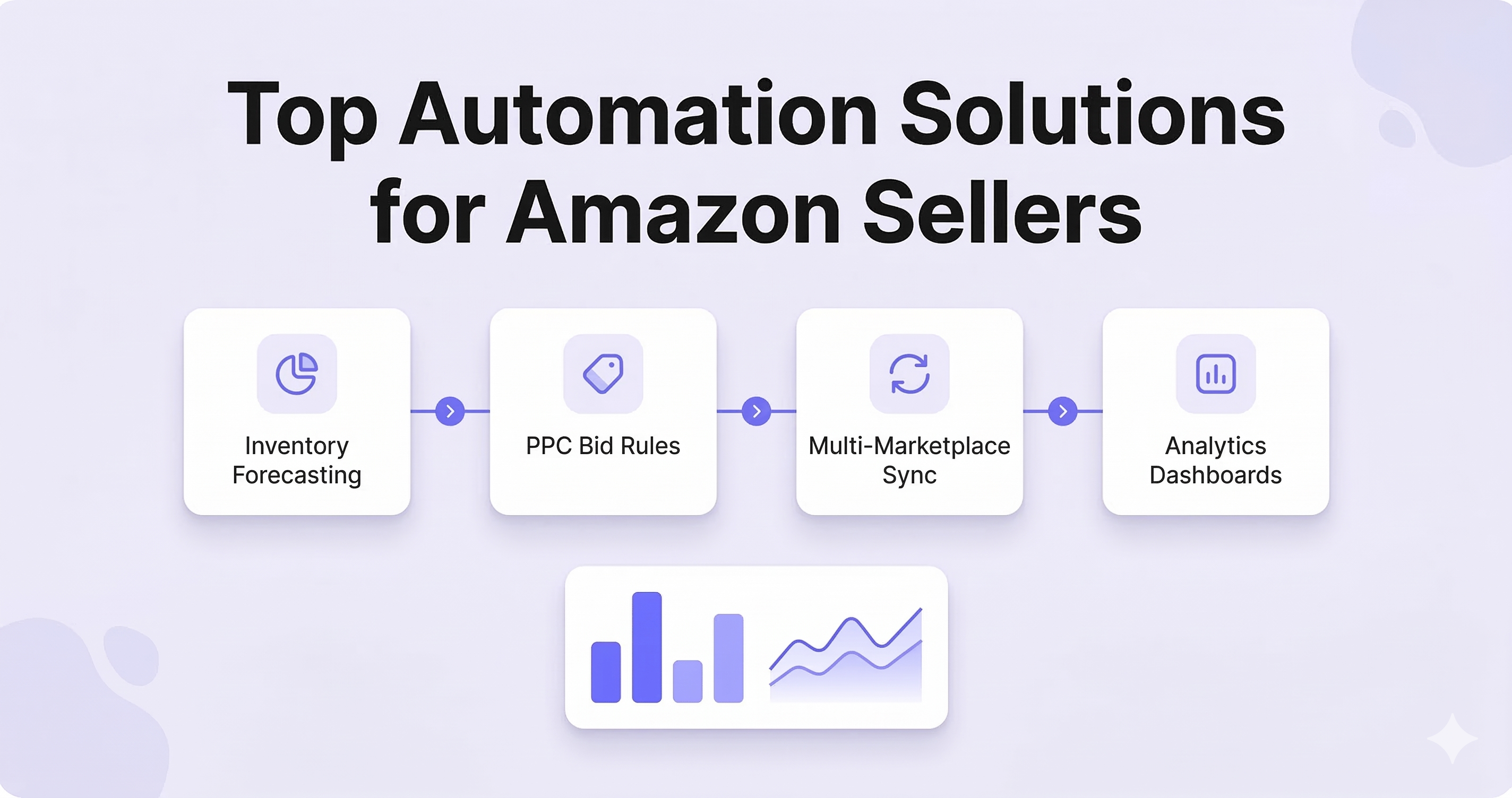
- Inventory forecasting and replenishment
- PPC bid rules and budget controls
- Performance analytics reporting
- Review request scheduling (policy compliant)
- Financial tracking
- Multi-marketplace synchronization
- Alert systems for anomalies
These are the common amazon seller processes to automate first because they consume time but follow predictable logic. Automation supports optimization. It does not replace oversight.
Amazon Automation Tools and Systems in Action
Automation is not one tool. It is a connected system. Disconnected tools create fragmented visibility. Integrated systems create control.
Amazon automation tools explained
Structurally, amazon automation tools explained means platforms that pull data through integrations, process it in real time, apply rule-based logic, and update dashboards automatically.
A mature automation setup includes:
- Inventory forecasting modules
- PPC automation engines
- Analytics dashboards
- Monitoring alerts
- Data pipelines across marketplaces
The value is not the tool itself. The value is synchronization between systems.
How automation improves Amazon seller productivity in real time
Let's look at how automation improves amazon seller productivity operationally.
Without automation: hours spent checking KPIs, reactive restocking, delayed bid adjustments, scattered analytics.
With automation: monitoring runs 24/7, alerts trigger instantly, reports update automatically, decisions rely on structured data.
This is precisely how Amazon sellers save time with automation — by removing repetitive execution from their daily workflow. Productivity increases because decision-making becomes faster and cleaner.
Examples of Amazon Automation Workflows
Here are practical examples of amazon automation workflows that operate at scale.
1. Inventory Replenishment Workflow
- Pull rolling 30 / 60 / 90-day sales
- Apply demand analytics
- Calculate safety stock
- Trigger reorder at threshold
- Notify supplier automatically
Result: fewer stockouts, smoother cash flow planning, predictable scaling.
2. PPC Performance Control Workflow
- Monitor ACOS and conversion rate
- If ACOS exceeds target → decrease bids
- If conversion improves → increase budget
- Log all changes in dashboards
This keeps campaigns within performance boundaries without constant manual supervision.
3. Multi-Marketplace Synchronization Workflow
- Sync inventory across regions
- Detect discrepancies automatically
- Trigger alert if mismatch appears
- Update financial reporting
Cross-market synchronization reduces operational risk and prevents overselling.
How Amazon Automation Helps Scale Business
The real leverage appears when growth accelerates. The question is not whether automation saves time. It's how amazon automation helps scale business sustainably.
Scaling manually means more staff, more spreadsheets, more coordination complexity.
Scaling with automation means standardised workflows, centralised analytics, consistent monitoring, and repeatable processes.
Scaling requires systems. Systems require automation.
Common Mistakes When Setting Up Automation
Automation amplifies whatever foundation you build on.
Over-automation without understanding business processes
One frequent mistake is automating unclear workflows. If your process is inconsistent, automation will replicate inconsistency faster. Map the workflow first. Then automate execution.
Why poor data breaks even the best automation workflows
Automation depends on clean data.
- Incorrect inventory inputs break reorder pipelines.
- Inaccurate conversion data disrupts PPC rules.
- Faulty integrations corrupt reporting.
Strong monitoring and reliable analytics are mandatory. Automation improves structured systems. It does not repair broken ones.
How to Build a Smart Automation Strategy for Your Amazon Business
Many sellers ask: how to automate amazon seller tasks without disrupting operations. The answer is phased implementation.
What to automate first and why it matters
Start with tasks that are repetitive, measurable, and rule-driven.
- Low-stock alerts
- Basic PPC rules
- Automated performance dashboards
- Financial monitoring
These deliver immediate efficiency gains and measurable optimization improvements.
Measuring impact and refining automation workflows
Automation should be evaluated continuously. Track time saved weekly, stockout reduction, ACOS stability, and revenue consistency.
Refine logic as your business grows. Well-built automation workflows for Amazon sellers evolve alongside scaling operations.
Conclusion
Why automation is now a core part of every Amazon business
Competition is tighter. Margins are thinner. Data volume is larger. Manual execution limits growth. Structured automation increases productivity, improves monitoring, and creates operational stability. Automation is no longer optional infrastructure.
Using NeonPanel to simplify and manage your Amazon automation ecosystem
Most sellers operate multiple disconnected tools. NeonPanel centralises dashboards, analytics, integrations, and monitoring into one ecosystem. Instead of fragmented reporting and manual coordination, sellers gain synchronised data pipelines and structured visibility. That's how amazon automation helps scale business — and how it becomes manageable.