

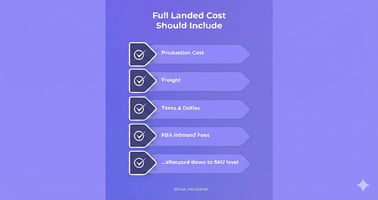
What is total landed cost? Total landed cost is the full cost of a product, including production,...
In this article
- What Does Landed Cost Mean?
- Why Landed Cost Is Important for Businesses
- What Factors Affect Landed Cost?
- Landed Cost Formula Explained
- How to Calculate Landed Cost Step by Step
- Landed Cost Example (Practical Case Study)
- How Landed Cost Impacts Pricing Strategy
- Manual Calculation vs. Landed Cost Software
- Common Mistakes in Landed Cost Calculation
- Conclusion
- FAQ
What is landed cost for importers and ecommerce brands? It is the all-in acquisition cost per unit once goods arrive at your warehouse — supplier price plus freight, duties, insurance, and handling. Accurate landed cost discipline protects margins, pricing decisions, and cash flow.
When importing goods from abroad, businesses often focus only on the product price. However, the true cost of bringing a product to your warehouse or final destination is much more than just the supplier's invoice. This total expense is called landed cost. Understanding it is essential for pricing, budgeting, and profitability.
What Does Landed Cost Mean?
The landed cost definition is the total cost of a product once it has arrived at your warehouse or store, including every expense incurred along the way. This means it is not just the price you pay your supplier but also additional costs such as shipping, customs duties, taxes, insurance, and other fees.
In other words, landed cost meaning is the real cost of a product landed and ready for sale. By understanding this, businesses can calculate the exact landed cost price, rather than relying on incomplete figures that ignore important factors.
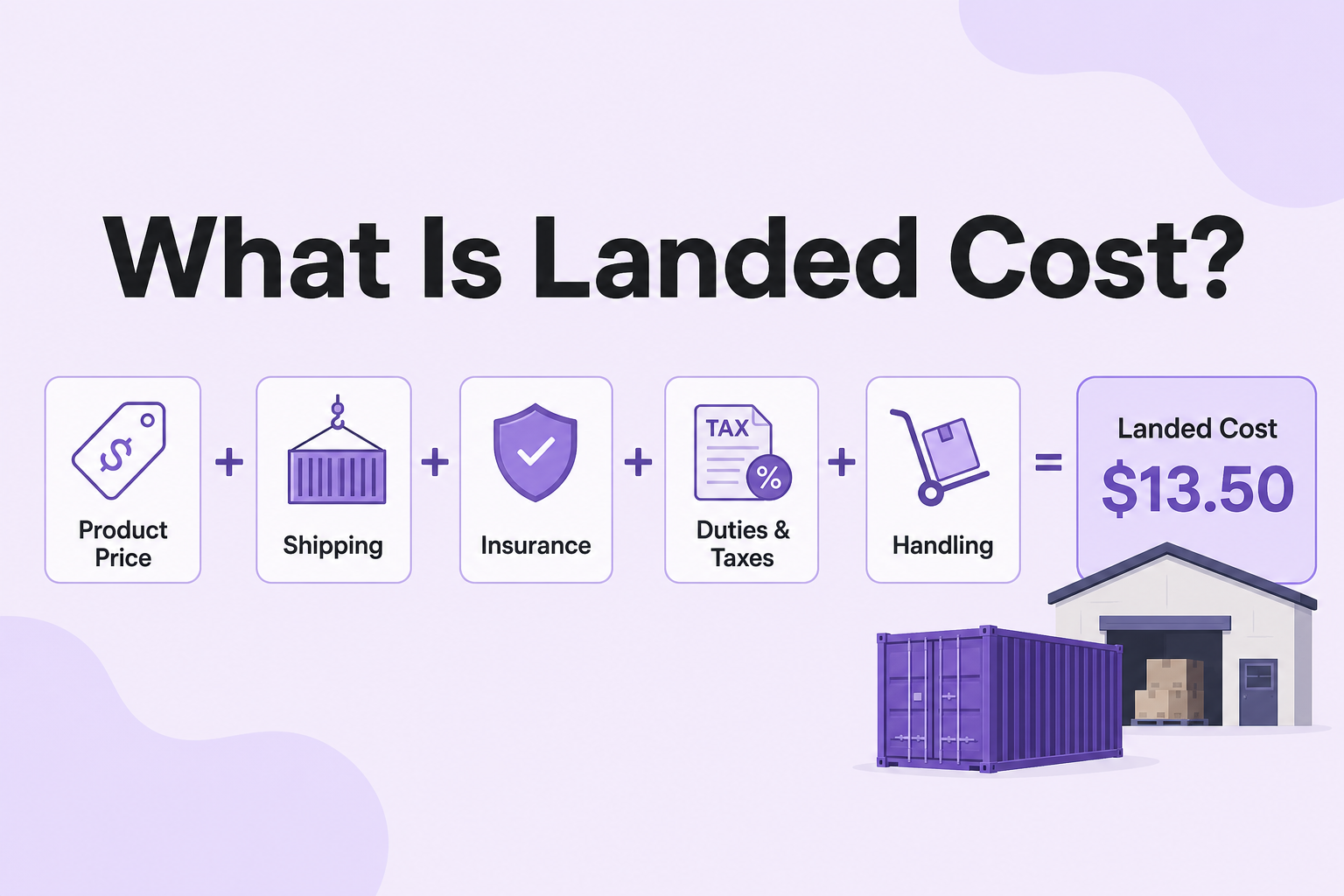
Example: If you buy a product for $10, ship it for $2, pay $1 in customs, and $0.50 in insurance, the estimated landed cost is $13.50. This is the amount that truly affects your profit margin.
Knowing what is a landed cost helps companies:
- Set competitive prices without losing money
- Analyze profitability accurately
- Plan budgets and cash flow efficiently
- Compare suppliers effectively
Why Landed Cost Is Important for Businesses
Many businesses underestimate the impact of landed costs, which can lead to unexpected losses. When all expenses are not considered, a product might appear profitable on paper but actually reduce margins once hidden fees are accounted for.
Here is why understanding landed cost is crucial:
- Accurate pricing strategy — knowing the total cost ensures your selling price covers all expenses and generates profit
- Better financial planning — helps forecast cash flow and anticipate import-related expenses
- Supplier comparison — allows you to choose the most cost-effective supplier by including shipping, duties, and other fees
- Supply chain efficiency — helps identify expensive steps or inefficiencies in the logistics process
- Risk reduction — prevents unexpected fees or losses from overlooked costs
For ecommerce businesses, wholesalers, and manufacturers, calculating estimated landed cost before shipping is key to maintaining smooth operations and profitability. For a deeper look at how landed cost connects to inventory valuation and COGS, see COGS vs Landed Cost.
What Factors Affect Landed Cost?
The landed cost calculation is affected by multiple factors, and missing even one can lead to incorrect pricing. The main factors include:
- Product price — the supplier's invoice amount is the base cost
- Shipping costs — freight charges for air, sea, or land transportation
- Insurance — protects against damage, loss, or theft during transit
- Customs duties and tariffs — government fees applied on imported goods
- Taxes — VAT or other local taxes
- Handling fees — port or warehouse charges, customs clearance fees
- Storage — costs for temporary storage at warehouses or ports
- Currency fluctuations — changes in exchange rates can impact total cost
Even small overlooked fees, like port surcharges or minor customs handling, can add up. That is why a comprehensive analysis of all factors is essential to get a realistic landed cost price.
Landed Cost Formula Explained
The landed cost formula helps businesses calculate the true expense of imported goods. At its core, the formula is:
Landed Cost = Product Price + Shipping + Insurance + Duties + Taxes + Additional Fees
Breaking it down:
- Product price — the base cost charged by the supplier
- Shipping — freight charges for transportation
- Insurance — coverage against potential transit issues
- Duties and tariffs — government import charges
- Taxes — VAT or other applicable taxes
- Additional fees — brokerage, handling, and storage costs
While this formula seems straightforward, real-world calculations can be more complex, especially for multiple products, different countries, or fluctuating rates. That is why accurate landed cost calculation often requires detailed tracking of all components.
How to Calculate Landed Cost Step by Step
To calculate landed cost accurately, follow these steps:
- Determine the supplier's product price. Confirm the exact unit price and total invoice amount.
- Add transportation costs. Include all freight, fuel surcharges, and delivery fees.
- Calculate customs duties. Use the correct tariff rate based on product classification and country-specific rules.
- Include taxes. Factor in VAT or local taxes to avoid unexpected costs.
- Add insurance and handling charges. Include any insurance, port fees, or warehouse handling charges.
- Final review. Sum all costs to determine the estimated landed cost per unit. Double-check for overlooked fees.
Businesses can also use a landed cost calculator or landed cost software to automate this process. Automation reduces errors and saves time, especially for large orders or multiple products.
Landed Cost Example (Practical Case Study)
Consider a business importing electronic accessories. This landed cost example shows how each line item builds the total:
| Cost Component | Amount |
|---|---|
| Product price | $10,000 |
| Shipping | $1,500 |
| Insurance | $200 |
| Customs duties (10%) | $1,000 |
| VAT (5%) | $500 |
| Miscellaneous fees | $300 |
| Total landed cost | $13,500 |
If the shipment contains 1,000 units, the landed cost per unit is $13.50. This shows how the final landed cost price is higher than the supplier's base price. Companies that neglect such costs may underestimate selling prices and shrink profits.
How Landed Cost Impacts Pricing Strategy
Your pricing strategy should always reflect the true landed cost. Ignoring additional factors can lead to underpricing products, reduced profit margins, and poor financial forecasts.
By using a thorough landed cost calculation, businesses can:
- Set profitable yet competitive prices
- Adjust margins based on real costs
- Optimize supplier selection
- Ensure long-term financial stability
Knowing the landed cost meaning allows for more strategic decision-making and smarter price adjustments. When landed costs are capitalized into inventory at the batch level, reported margins stay aligned with what you actually paid — see Fully Landed Cost Explained for how that works in practice.
Manual Calculation vs. Landed Cost Software
Many businesses calculate landed costs manually using spreadsheets. While feasible for small operations, this approach has limitations: human error, outdated currency rates, overlooked fees, and a time-consuming process.
Landed cost software automates the entire calculation process. Benefits include:
- Real-time updates on shipping, tariffs, and taxes
- Accurate estimated landed cost per unit
- Quick scenario analysis for multiple products
- Streamlined reporting for supply chain and finance teams
Investing in software reduces errors, saves time, and provides valuable insights for pricing and profitability analysis. NeonPanel allocates inbound freight, duties, and prep fees to each receipt batch and tracks consumption in true FIFO order — so your landed cost data flows directly into COGS and your accounting ledger. Learn more about Landed Cost & FIFO COGS in NeonPanel.
Common Mistakes in Landed Cost Calculation
Even experienced importers make mistakes. Common errors include:
- Ignoring minor fees or surcharges
- Using outdated duty rates
- Forgetting insurance costs
- Misclassifying products for customs
- Not performing regular cost analysis
These mistakes can significantly affect the landed cost price and reduce profitability. Regular updates, careful review, and automation are key to avoiding costly errors. For operational guidance on tracking landed costs across channels, see What Is Landed Cost and Why It Matters.
Conclusion
Understanding the full landed cost definition is crucial for any business involved in importing or global trade. The true landed cost meaning extends far beyond the supplier's invoice, including shipping, customs duties, taxes, insurance, and handling fees.
Accurate landed cost calculation allows businesses to set profitable and competitive prices, improve financial planning and forecasting, reduce unexpected expenses, and strengthen supply chain efficiency.
Whether you use manual methods or landed cost software, the most important step is to carefully calculate every factor and perform regular analysis. This ensures you maintain healthy profit margins, make informed business decisions, and grow sustainably in competitive markets.
Further reading: COGS vs Landed Cost · Fully Landed Cost Explained · What Is Landed Cost and Why It Matters
FAQ
What is a landed cost and why is it important?
A landed cost is the total expense of getting a product from the supplier to your warehouse, including shipping, duties, taxes, insurance, and handling. Understanding it ensures accurate pricing, proper budgeting, and protects profit margins.
How do I calculate the landed cost of a product?
To calculate landed cost, sum up the product price, shipping, insurance, duties, taxes, and any additional fees. You can perform manual calculations or use a landed cost calculator for faster and more accurate results.
Can I estimate landed cost before placing an order?
Yes. By requesting detailed quotes, checking customs duties, calculating shipping and insurance, and including taxes, you can get an estimated landed cost to guide pricing and profitability decisions.
How can landed cost software help my business?
Landed cost software automates the calculation process, integrates real-time shipping and tariff data, reduces human error, and provides actionable insights for pricing, budgeting, and supply chain analysis.
Does landed cost affect pricing strategy?
Absolutely. Your selling price should reflect the total landed cost. Ignoring additional factors like duties, taxes, or shipping may lead to underpricing and reduced profit margins.
Are there any online tools for quick landed cost estimation?
Yes. Many businesses use online landed cost calculators or platforms to generate accurate, real-time estimates for imported goods.

.png?height=200&name=Accounting%20Matters%20(EBITDA).png)