

.png?height=200&name=Accounting%20Matters%20(EBITDA).png)
TL;DR: Most Amazon brands expense FBA inbound fees as operating costs. That pushes EBITDA down and...
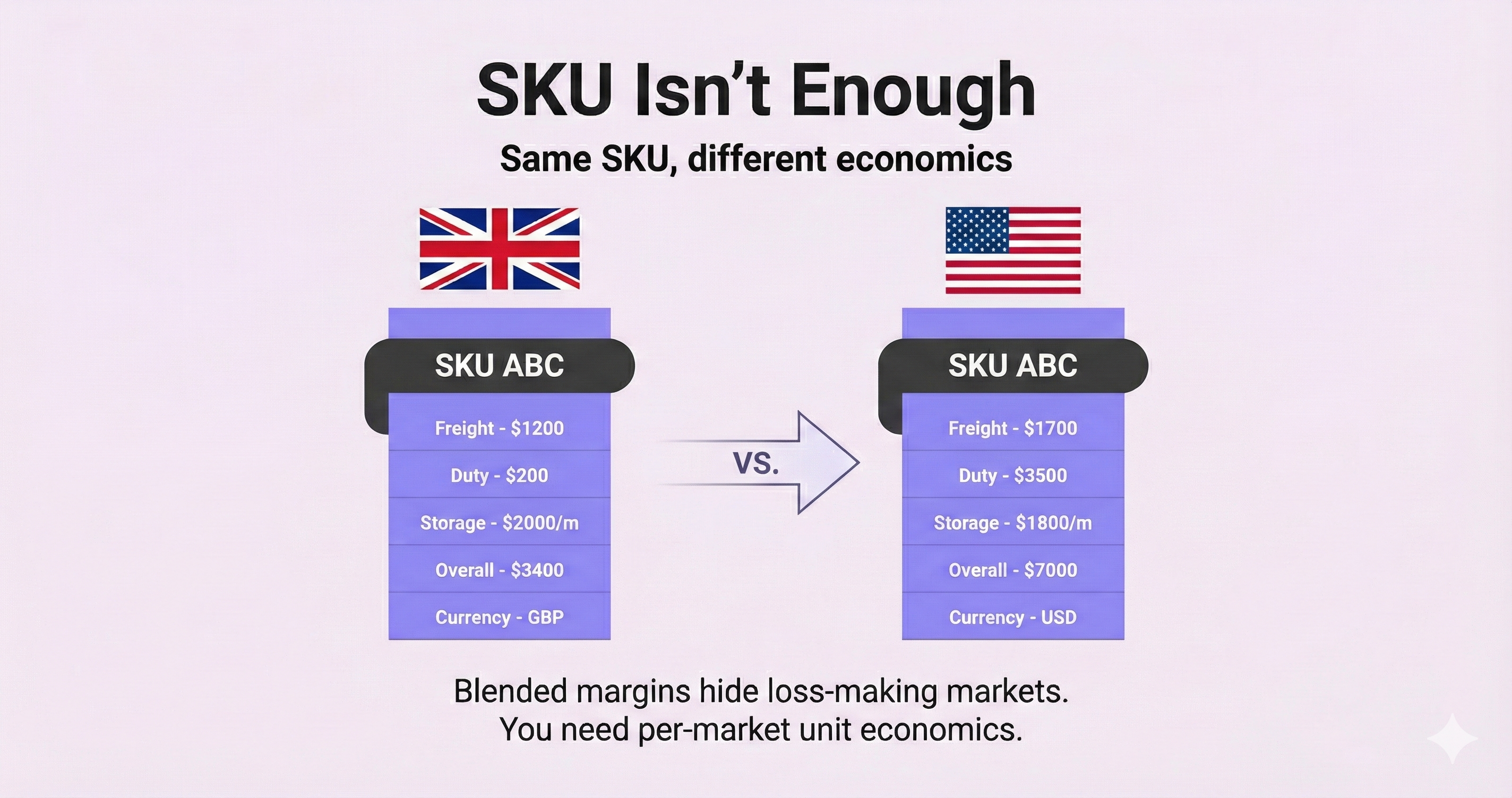
TL;DR: Treating an SKU as “one product with one cost” hides huge differences between countries and marketplaces. Freight lanes, duties, storage, and FX can make the same SKU wildly profitable in one market and barely breakeven (or loss-making) in another. This article shows why you need per-market unit economics and how to build them without drowning in spreadsheets.
Same SKU, different reality
Here is a simple example:
-
SKU ABC – UK
-
Freight: $1,200
-
Duty: $200
-
Storage: $2,000/month
-
Overall: $3,400 (in GBP)
-
vs.
-
SKU ABC – US
-
Freight: $1,700
-
Duty: $3,500
-
Storage: $1,800/month
-
Overall: $7,000 (in USD)
-
Same product, same packaging, same brand.
But the cost structure is completely different:
-
Different freight lanes & surcharges
-
Different duty rates and trade agreements
-
Different storage & fulfillment fees
-
Different currencies and FX rates
If your system stores one cost per SKU, it will average those realities together. On paper the SKU might show a healthy global margin. In reality:
-
The UK might be printing cash
-
The US might be barely breaking even or losing money
That’s how “nice” blended margins hide burning markets.
Why a SKU-only view breaks down
When everything rolls up to a single SKU cost and margin, several bad things happen.
1. Blended margins hide loss-making markets
You might see:
“SKU ABC – 28% gross margin globally.”
But beneath that:
-
UK: 42% margin
-
US: 8% margin
Blended together, it looks fine. You keep scaling ads in both regions, unaware that one of them is dragging down the whole SKU.
2. Pricing decisions get distorted
If you only see a global average cost:
-
You may under-price in high-cost countries (US)
-
Or over-price in low-cost countries (UK) and lose share to local competitors
You need to know your true per-market cost floor before deciding on price and discount strategy in each region.
3. You misallocate inventory and working capital
Say you’re planning your next container:
-
You see SKU ABC is profitable overall
-
You split inventory across US and UK based on demand alone
But if your cost structure is much heavier in the US, the same units lock up more working capital for less return there. Without per-market unit economics, it’s very hard to decide:
-
Which market deserves more stock
-
Where you can afford to run deeper promos
-
Where you should slow down or even exit
4. FX noise and local fees make reports hard to trust
Even if you track landed cost correctly, combining:
-
GBP, EUR, USD
-
FBA/Fulfillment fees
-
Local VAT/GST rules
into one SKU-level view can make reports feel random. Without a structured approach, you’ll constantly wonder:
“Is this margin change real, or just FX and fee timing?”
What good multi-market unit economics look like
Instead of just “SKU ABC”, you want your system to think in terms like:
SKU ABC + Marketplace + Country + Currency (+ Warehouse)
For each of those combinations, you want to see:
-
Per-market landed cost per unit
Including product cost, freight, duties, brokerage, inbound handling, and other pre-sale costs. -
Per-market selling costs & fees
Referral/commission, fulfillment, storage, and payment fees specific to that marketplace and country. -
Per-market COGS and gross margin
So you can say, “SKU ABC in Amazon UK has a 40% gross margin; in Amazon US it’s 12%,” instead of staring at a blended 26%. -
Consistent FX handling
Either:-
Convert everything to a home currency (e.g., USD) for comparability, and
-
Preserve original transaction currency for audit and tax.
-
Platforms like NeonPanel are built for this kind of granularity: country-specific costs with no averages and the ability to drill into cost drivers for each batch.
A practical framework: “SKU x Market” mini P&L
For each SKU and market (e.g., SKU ABC in Amazon US), build a simple mini P&L:
-
Net Revenue
-
Gross sales
-
Less discounts & promos
-
Less platform-collected tax (if applicable)
-
-
COGS
-
Landed cost per unit (batch-level if possible)
-
Outbound shipping/packaging if directly tied to each order
-
-
Marketplace & payment fees
-
Referral/commission
-
Fulfillment pick/pack/weight fees
-
Storage
-
Other platform fees (returns processing, low-inventory fees, etc.)
-
-
Gross Margin
-
Net revenue – COGS – fees
-
Expressed as a % of revenue
-
-
(Optional) Allocated overhead & ad spend
-
PPC or other paid media specific to that SKU/market
-
Any truly direct overhead you want to include for internal unit economics
-
Once you have this for each SKU x Market, several decisions become straightforward:
-
Where to raise prices vs. where you can afford to be aggressive
-
Where to double down on ads vs. where to cut spend
-
Which markets deserve more PO volume and working capital
How to get there if you’re still living in spreadsheets
If you don’t have a system doing this automatically yet, here’s a “good enough” approach:
-
Tag every transaction by marketplace and country
-
Orders, fees, shipments, and returns should all carry a marketplace/country identifier (e.g.,
amazon.co.uk,amazon.com,shopify-uk).
-
-
Separate inbound cost batches by destination
-
Don’t mix “global freight” into a single bucket if containers are going to different regions.
-
Split freight and duties between the UK container and the US container, and record separate batch costs.
-
-
Use a consistent FX policy
-
Pick a source for FX rates (e.g., monthly average from your bank or accounting software).
-
Apply it consistently across all inbound and outbound transactions for that period.
-
-
Build a SKU x Market matrix once a month
-
Rows: SKUs
-
Columns (per market): units sold, revenue, COGS, fees, gross margin.
-
Don’t obsess over perfection at first; aim for directional accuracy and then refine.
-
-
Compare markets side-by-side
-
Rank SKUs by margin per market, not globally.
-
Highlight markets where you’re below a target margin threshold.
-
How NeonPanel operationalizes “SKU Isn’t Enough”
NeonPanel is built around the idea that per-market economics should be standard, not an extra project.
Here’s how it ties together what we’ve covered:
1. Country-specific costs with no averaging
-
Landed costs (product, freight, duties, etc.) are tracked per batch and destination, so UK and US containers for the same SKU carry different unit costs by design.
-
That flows into a FIFO engine that calculates COGS using actual batch costs, not a blended average.
2. Multi-channel, multi-warehouse visibility
-
View on-hand, in-transit, and reserved inventory by SKU across marketplaces and warehouses, so you can see exactly how much of SKU ABC sits in the UK vs. US and what it cost.
3. SKU-level profitability by marketplace
-
60+ built-in reports include SKU profitability and fee analysis, so you can compare the same SKU across different countries and channels.
-
CFO-grade P&Ls and SKU-level breakdowns mean you can hand investor-ready numbers to a buyer or lender without rebuilding everything in Excel.
4. Clean integration with accounting
-
Pre-configured, rule-based mappings for marketplace fees, refunds, and promotions push clean journals into QuickBooks or Xero, while preserving the underlying per-country detail in NeonPanel.
The result: instead of hoping your global SKU margin tells the full story, you can say with confidence:
“SKU ABC is worth scaling in the UK; in the US, we either need a price increase, a cost reduction, or we reduce emphasis.”
The mindset shift: SKU plus where and how it’s sold
The core idea from your Instagram post is simple but powerful:
A SKU is not a single economic reality.
It’s a family of realities across countries, warehouses, and channels.
Once you start thinking in SKU x Market terms—and your tools support that—pricing, inventory allocation, and growth decisions become far less risky.